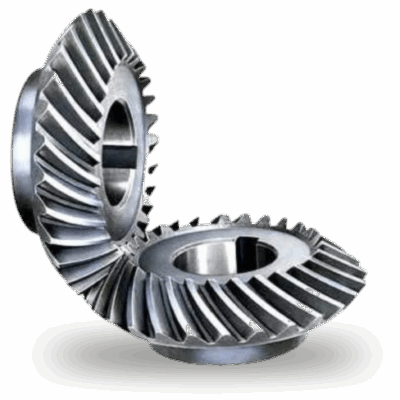
Spiral Gears
Spiral gears, also known as helical gears with a specific tooth configuration, are a type of gear with teeth that cut at an angle to the gear’s axis, forming a spiral pattern rather than being straight or parallel like spur gears. This unique design allows spiral gears to engage and disengage gradually, resulting in significantly smoother and quieter operation compared to their straight-toothed counterparts. The spiral angle, which is the angle between the tooth and the gear’s axis, can be customized for different applications, with typical angles ranging from 15 to 45 degrees. This gradual engagement also distributes the load more evenly across multiple teeth at any given time, reducing stress concentrations and increasing the gear’s load-carrying capacity and service life. Spiral gears are particularly effective in applications requiring high torque transmission and smooth operation, such as automotive transmissions and industrial machinery.
The helical tooth configuration of spiral gears also provides greater flexibility in design, as they can be used to transmit power between both parallel and non-parallel shafts. When used for intersecting shafts, they are often referred to as spiral bevel gears, which combine the advantages of spiral teeth with the ability to transfer motion between shafts at various angles. However, the angled teeth of spiral gears introduce axial or thrust forces that must be managed with appropriate thrust bearings, adding some complexity to the supporting structure compared to spur gears. Despite this, the benefits of smoother operation, higher load capacity, and reduced noise typically outweigh these considerations in most applications. Spiral gears are commonly manufactured from materials such as case-hardened steel, alloy steel, or specialized alloys, with heat treatment processes applied to enhance their strength and wear resistance for demanding operating conditions.